

 русский
  Kreyòl Ayisyen
 Gaeilgenah Éireann
 Norsk
Norsk Srbija jezik (latinica)
 bosanski
 Português
 Français
 magyar
 বাংলা
বাংলা Polski


In the field of pigment applications, the selection of high-molecular polymers directly affects coloring effects, stability, and process adaptability. As a leading industry supplier, Hangzhou Rainbow Import & Export Co., Ltd. has long focused on the R&D and production of N-vinylpyrrolidone (NVP) series products, covering two core categories: homopolymers (NVP Homopolymers) and polyvinylpyrrolidone (PVP). This article analyzes the key differences between the two from dimensions such as chemical properties, performance, and application scenarios, providing technical references for pigment industry practitioners.
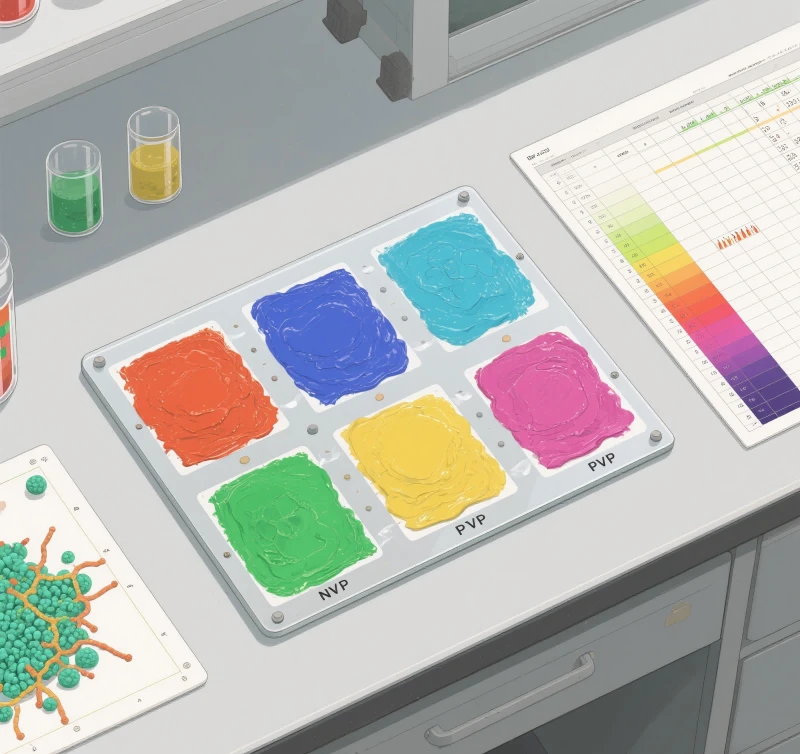
Differences in Chemical Structure and Synthesis Processes
NVP Homopolymers
NVP homopolymers are formed by free-radical polymerization of a single N-vinylpyrrolidone (NVP) monomer, with only pyrrolidone ring structures in the molecular chain. Their synthesis typically uses solution polymerization, controlling molecular weight by adjusting monomer concentration, temperature, and initiator dosage, resulting in a narrow molecular weight range and high structural uniformity.
PVP (Polyvinylpyrrolidone)
PVP also uses NVP as a monomer but forms a more complex molecular network through copolymerization or cross-linking reactions. Classified by molecular weight, PVP is divided into types K15, K30, K60, K90, etc. The larger the K value, the higher the molecular weight, viscosity, and adhesiveness. In industrial production, PVP mostly employs solution polymerization or bulk polymerization, requiring strict control of reaction conditions to avoid local overheating and residual monomers.
Key Difference: NVP homopolymers have a linear structure, while PVP may contain branched or cross-linked structures, leading to significant differences in intermolecular forces and physical properties.
Comparison of Physical Properties
Solubility and Viscosity
NVP homopolymers exhibit excellent solubility in water and organic solvents, particularly showing low viscosity in polar solvents, making them suitable as active diluents to adjust coating fluidity. The solubility of PVP decreases with increasing K value; high-K types (e.g., K90) form high-viscosity solutions in water, suitable for scenarios requiring strong adhesiveness.
Thermal Stability
NVP homopolymers have weaker thermal stability, prone to decomposition or cross-linking reactions at high temperatures, limiting their application in high-temperature coatings. The thermal stability of PVP improves with molecular weight; the K90 type can withstand temperatures above 200°C, suitable for high-temperature curing coating systems.
Hygroscopicity
NVP homopolymers have strong hygroscopicity, which may affect pigment storage stability in humid environments. PVP has lower hygroscopicity, especially in high-K value types, making it suitable for pigment applications in outdoor or high-humidity environments.
Pigment Dispersion and Stability Performance
Dispersion Efficiency
PVP, with its amphiphilic structure (pyrrolidone ring and vinyl chain), can adsorb onto the pigment surface through hydrogen bonding and electrostatic interactions, effectively reducing surface energy between particles and preventing flocculation and sedimentation. For example, adding PVP-K30 to inks can improve pigment dispersion stability to over 6 months, with fewer nozzle blockages.
NVP homopolymers have weaker dispersion ability, more often used as auxiliary dispersants in combination with other surfactants or in basic coatings with lower dispersion requirements.
Anti-Sedimentation
PVP forms a stable colloidal protective layer in water-based pigment systems, significantly delaying pigment sedimentation. For instance, adding PVP-K60 to latex paints can increase pigment suspension stability by over 30%.
Due to the lack of strong adsorption groups, NVP homopolymers have weaker anti-sedimentation performance and need to be used with thickeners to maintain system stability.
Film-Forming Properties and Adhesion Analysis
Film-Forming Characteristics
PVP forms transparent, uniform films during drying, enhancing the gloss and wear resistance of pigment coatings. For example, adding PVP-K90 to coatings can increase film hardness by 20% while maintaining good flexibility.
NVP homopolymers have weaker film-forming properties, mostly used to adjust coating viscosity or as film-forming auxiliaries, requiring combination with other resins to enhance film performance.
Adhesion
The pyrrolidone rings in NVP homopolymer molecular chains can form hydrogen bonds with the substrate surface, enhancing coating adhesion. For example, adding NVP homopolymers to metal coatings can improve adhesion to Grade 0 (ISO 2409 standard).
PVP adhesion depends on molecular weight and cross-linking degree; high-K types perform excellently on polar substrates (e.g., glass, plastic) but show weaker adhesion on non-polar surfaces.
Cost and Environmental Considerations
Production Costs
The synthesis process of NVP homopolymers is relatively simple with lower raw material costs, suitable for large-scale production. PVP has higher production costs due to the need to control molecular weight distribution and residual monomers, especially with significant premiums for pharmaceutical and electronic grades.
Hangzhou Rainbow's Technical Advantage: The company uses a new catalytic hydrogenation decarboxylation process, reducing NVP homopolymer energy consumption by 20%, by-products by 40%, and unit costs by 15%, significantly enhancing market competitiveness.
Environmental Friendliness
NVP homopolymers are biodegradable, complying with EU REACH regulations for environmentally friendly materials. PVP has poorer biodegradability, but optimizing the polymerization process (e.g., using water-soluble initiators instead of AIBN) can reduce toxic by-product generation.
Company Practices: Hangzhou Rainbow's PVP production line is GMP-certified, adopting continuous production processes to reduce three-waste emissions by 20%, with products meeting FDA and EU cosmetic regulations.
Technical Advantages and Product Applications of Hangzhou Rainbow
Product Matrix
The company offers a full range of NVP homopolymers and PVP products, including:
NVP Homopolymers: Low molecular weight (K15-K30) for ink dispersants, high molecular weight (K60-K90) for coating film formers.
PVP: Industrial grades (K30-K90) for pigment dispersion, pharmaceutical grades (K30) for food-contact coatings, and electronic grades (K120) for photoresists.
Application Cases
Water-based Inks: The combination of PVP-K30 and NVP homopolymers can control pigment dispersion particle size distribution at 100-200nm, improving printing clarity by 15% and accelerating drying speed by 30%.
High-Temperature Coatings: PVP-K90 is used in automotive original equipment manufacturer (OEM) paints, withstanding 180°C baking, achieving a film hardness of 3H, and enhancing weather resistance by 40%.
Environmentally Friendly Pigments: NVP homopolymers combined with nano-silver are used in antibacterial coatings, maintaining pigment performance while achieving a 99.9% antibacterial rate, complying with EU RoHS directives.
Technological Innovations
The company collaborates with universities to develop photocurable NVP derivatives with a double bond conversion rate of 92%, replacing traditional ethoxylated bisphenol A dimethacrylate for 3D printing dental materials.
Conclusion
The differences between NVP homopolymers and PVP in pigment applications mainly lie in chemical structure, physical properties, and functional performance:
NVP Homopolymers: Low viscosity, high adhesion, and low cost, suitable for basic coatings and scenarios with low dispersion requirements.
PVP: Strong dispersion, high stability, and excellent thermal stability, suitable for high-end inks, high-temperature coatings, and pigment systems in complex environments.
Hangzhou Rainbow Import & Export Co., Ltd. provides customized solutions for customers with advanced production processes and a full-range product matrix, helping the pigment industry upgrade toward efficiency and environmental friendliness. For more product information, visit the official website (https://www.sunvidone.com/) or contact our technical team.